Thursday, May 19, 2011

Russian Root Vegetable Salad-Vinegret

I was in charge of Teacher Appreciation Lunch last week and was quite busy with preparations so I was not able to post, but now I have to, since the recipes I used were liked and requested by the teacher's themselves.
This salad is a classic Russian salad, that every kid grows up eating. It is a staple of Russian cuisine called Vinegret. It simply delicious and easy to make, but  few ingredients may surprise you.
Sorry about the quality of the picture, it was made with an iPhone
and will be replaced when I make this salad again(one of these days).
Although this is not a flattering photo, the salad is really good. These colors also do not stay, the longer the salad stays mixed, the more it becomes uniformly of purple beet color. That does not affect the taste, however.
I believe that dressing makes the salad and here I use non-refined sunflower oil. My mom says that the shoe laces will be delicious if served with garlic sauce. Thus, sesame oil will give most of the salads oriental flare, and extra virgin olive oil will definitely remind you of the Mediterranean. Here, most of the Russian flavor comes in the form of the oil, it is very important. Having said that, I do not expect that you will rush out to get it, so it can be substituted with a flavorless oil. However, if you are interested it is found in Russian stores or those that also cater to Russian clientele like Persian store in San Jose, called Setareh Market.
3-4  potatoes (I prefer Yukon Gold but baking potatoes will do, just use medium sized)
2-3 large beets (about the size of the potatoes or somewhat less)
2-3 carrots
1 red onion
3/4-1 can of green peas drained
1 large or several small dill pickles diced small
1 cup of squeezed dry sauerkraut (approx 1/2 of 1lbs glass jar)
3-4 sprigs of each fresh dill and flat leaf parsley or 1/2-1 of dry dill.
1/2 -3/4 cup of non refined sunflower oil
Boil the root vegetables until done. If you are concerned about the color of the presentations, beets should be boiled separately. Carrots will take less time to cook, so either take them out sooner, or add them to the pot later. As soon as the vegetables done, take it out of water and allow to cool enough where you can handle them. The potatoes are peeled and diced in quarter inch dice and placed a large bowl. The beets are diced slightly smaller and placed in a separate bowl mixed with sunflower oil. The rest of the ingredients like carrots and onion diced and added to potatoes but pickles are diced very small. Drain canned peas and add to the salad. Sauerkraut is drained and squeezed well. It seems that you are adding a lot of it to the salad but consider that vegetables were not salted when they were cooked, so both pickles and sauerkraut definitely give a lot of flavor.  A few sprigs of parsley and dill is finely chopped but dill can be substituted for dry. Dill is one of the most popular Russian herbs along with flat leaf parsley and is used almost always either ar garnish or an ingredient. Unlike most dry spices, that carry stronger flavor once they are dry, I do not find it to be true in the case of dill and add more if it is dry. Do not substitute dry parsley for fresh, it does not work if fresh parsley is not available it is OK not to add any. Salt and pepper are added last but it needs to be done with consideration to other salty ingredients and I do it to taste and can't tell how much exactly. Some pickles are saltier then others.
Traditionally, this salad is made not with German style sauerkraut but the Russian style fermented cabbage that takes less time and has somewhat different taste. Occasionally, I make it myself and more often my mother-in-law makes fermented cabbage and I will share the method and the recipe sometimes later. Using canned  German sauerkraut is my adaptation of the recipe.  If I make this salad for a party I do not mix in the beets until it is almost time to eat, but for the family I try to mix beets and oil with the rest of ingredients almost right away while the potatoes are still hot. Salad is going to be uniformly beet in color in a few hours anyway, so I prefer the flavor over presentation at home. It does make for an impressive looking salad, but I like it because of all the vegetables that are in it.

Thursday, May 5, 2011

Jalapeno poppers

My husband loves heat! He puts hot sauce on everything, and the kids try to emulate him and started using hot sauce on their food, too. Sometimes I take it personally, as if my idea of a dish and the flavors I added was not enough for them. I'm beginning to theorise that heat must be like an illegal substance, the more you use, the more you want to use it. The amount of hot sauce seem to increase gradually. Every  time I make a salad my husband  tells me what's missing : "Jalapenos!" It's our family's inside joke now! With this dish I was hoping to accomplish complete satisfaction. Imagine my surprise, when the dish that was originally intended to be spicy was not.  I'm not sure is it was something about the pepper that I bought but even the kids agreed there was no heat at all. Next time I'm making this dish I will definitely leave the seeds and membranes in the peppers. As usual, I made this dish after reading about all the recipes I can on the net and coming up with my own.
12 fresh jalapeno peppers, halved lengthwise, stems, seeds and membranes removed
1 cup (8 ounces) cream cheese, softened
1 cup grated Mexican blend cheeses (usually Monterey Jack and Mild Cheddar are in the blend and will do)
1/2 teaspoon ground cumin
about 3 cloves of garlic pressed
3-4 tbl sp chopped fresh cilantro
salt pepper to taste
2 eggs
1 1/2 cup milk
1 cup all-purpose flour (may be more)
1 cup dry bread crumbs
1-2 cup oil for frying
In a bowl, blend together the cream cheese, grated cheeses, cumin, garlic and chopped cilantro.Add salt and pepper. Wearing gloves is recommended for the next step. After cutting in half clean Jalapenos from seeds and membranes. Fill the halves with the cream cheese mixture. Spread flour on shallow plate and add some salt and black pepper to it. Mix bread crumbs with corn flake crumbs in a bowl. Beat together egg and milk in another bowl. Dip the filed pepper in the egg and milk mixture then dredge in flour. Then dip in the egg and milk mixture again and roll in the corn flake and bread crumb mix. Fry in the oil in a medium but deep skillet for about 2-3 min, turning once so that the color is uniform and golden brown. I also used some regular small sweet peppers. Sometimes they are sold in Costco in the bag and are about the size of the jalapenos. So that's the yellow pepper you see on the picture.

Wednesday, May 4, 2011

Vegetarian lasagna

I love lasagna and usually only make a vegetarian kind. I think it is an easy dish to make. Practically all of the vegetables you have in the fridge will go well into it. This is such an adaptable dish. you cant go wrong here, it is impossible not to get a great dinner. I also vary the sauce I use, sometimes it's regular spaghetti sauce and sometimes Alfredo and do not make it more complicated than it needs to be, the sauce is from a jar. Lasagna may sound complicated but in fact a very easy dish to make.
The list of ingredients may be scary at first but I do not always use all of the vegetables on the list, just the ones I have in the fridge. The usual ingredients are onion, carrots, celery, the rest are interchangeable and include pepper, zucchini or summer squash, broccoli, cauliflower, green beans and or snow peas, frozen spinach and asparagus. If you do not have some thing like asparagus, add little more broccoli, if you do not have cauliflower add a little more carrot and pepper, and so on. You will not mess up the final result. As always there are ricotta cheese, mozzarella, garlic, Italian seasoning and another thing that I discovered that work well here is surprising but Persian mix sabsiash which is made of dehydrated leek, parsley and spinach. These ingredients are already present in the lasagna, so the overall taste is great.
1 chopped onion
1 chopped celery rib
2-3 sliced or shredded carrots
1 red or yellow chopped pepper
1 chopped large zucchini
1 cup broccoli
1 cup cauliflower
1 cup asparagus
1 cup chopped green beans
1 package of  frozen spinach (1 lbs)
3-4 cloves of garlic
1 egg
1 lbs package of ricotta cheese
1 1/2 cup shredded cheese like mozzarella
1 can of spaghetti or Alfredo sauce
1 box of lasagna noodles
1 tbsp of Italian seasoning
1 tbsp of sabziash
1/4 tsp crushed red peppers
salt pepper
The cooking method could be seen on this video or is listed below.
Cook lasagna pasta according to directions.
Saute vegetables, adding them in one at a time and stirring the contents. Add the about 2 chopped garlic and all of the seasonings and let the vegetables cool. In a large bowl combine the ricotta egg, and 1 cup of shredded cheese. Then add cooled cooked vegetables.  Divide the mixture in 2 or 3 parts, that will depend on the number of layers you are planning on adding. in the lasagna pan add some sauce to the bottom and press a garlic clove in the pan, mixing it well with the sauce. Layer the first noodles, then spoon the cheese and vegetable mixture. spoon over some sauce, then add another layer of noodles and repeat the procedure until you are done. Over the last noodles spoon remainder of the sauce and sprinkle with remainder 1/4 cup of the grated cheese. Bake at 350 F for about 30-40 min. Let lasagna rest for about 1- min before cutting it. Believe it or not but it is even better on the next day.

Tuesday, April 26, 2011

Stuffed Chicken Quarters

This recipe was inspired by Jewish dish called Helzel. The chicken skin is stuffed with fried in schmaltz onion and bread crumbs or matzo meal. This was a laborious dish but well received for Seder. I call it a cholesterol bomb, but I think everything is allowed in moderation, especially if it is only cooked once a year.
I removed skin of the chicken quarters, and extra chunk of fat that are always present on the quarters and set both aside. Then I took the bones out, creating one large rolled out piece of meat. The chicken fat was melted down in the  frying pan and one large chopped onion was fried in the oil. To it then about a cup of coarse matzo meal and matzo crumbs added. Not during Passover bread crumbs and ground corn flakes work really well. Once the crumbs got well coated in oil and mixed well with onion little water can be added to a consistency of cooked oatmeal. Salt, pepper, Mrs Dash or other your favorite spices can be added at this time. Once the stuffing is ready at 1-2 tblsp of it is placed in the inside part of the chicken. Then meat is folded and placed back inside the chicken skin, like in a sock. The seam is then pinned together with one or two toothpicks. Chicken quarters are placed seam down in a baking sheet and placed in the oven uncovered and baked at 350F for about 45 min or longer, that the skin turns golden brown and crispy.
10-12 chicken leg quarters
1 large onion
1-11/2 c coarse matzo meal and matzo crumbs or bread crumbs and ground corn flakes
about 1 c water

Monday, April 25, 2011

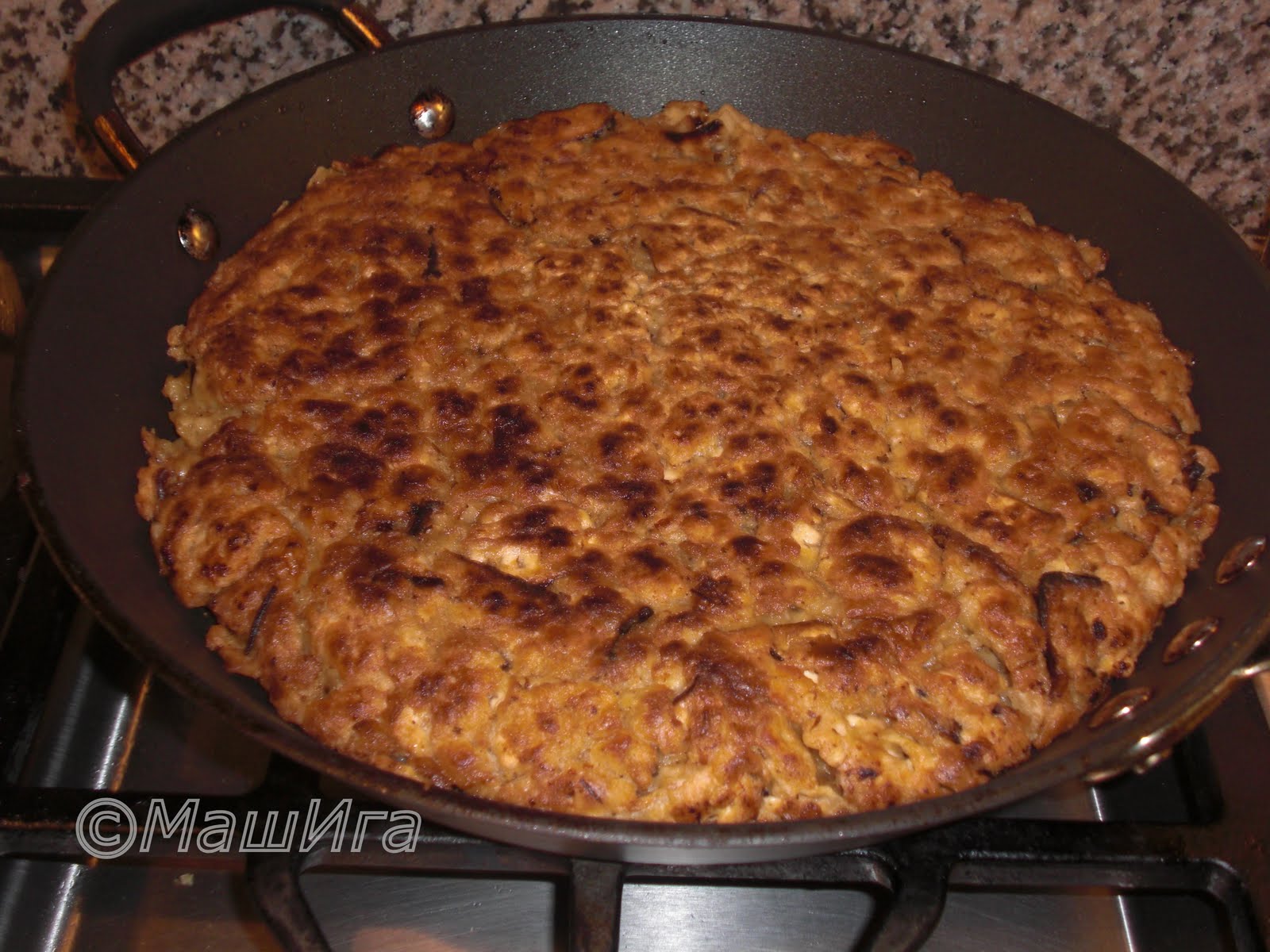
Fried Matzo


Jews are limited in what can be eaten during Passover. Matzo is eaten every day instead of bread, it is ground up instead of breadcrumbs and even back to be as fine as flour, except at this point it will never develop gluten and is used more for bulking up a cake recipe. Well, there are several ways to cook a matzo. I remember that when I was growing up, we always had it during Passover, but is was not official and never advertised to our neighbours. Well, I stopped asking why can't I bring it to school after a "girlfriend" of mine was trying to convince me that it is made with the blood of Christian children.... I know it sound absurd, but that was not, and is still, not uncommon believe among the Russian folks. The matzos was smuggled in to us from Moscow, where my uncle lived, and it could be purchased in a synagogue. There were no temples in the city where I grew up and nor churches that I can remember. There was one church in the middle of the city that would look like a cross from the plane and it survived the bombing and WWII but for one wing of the cross, and was converted to an archive, one old Tatar Mosque boarded up could also be found. My uncle would pay a train conductor to bring the package on board with him or her and given to my grandparents, who would take it from conductor upon arrival. Unthinkable these days, I know, but common practice those quieter times. The same way my grandma would send the vegetables, fruits and berries in the summer months to her son and his family in Moscow from the southern part of Soviet Union - Crimean Peninsula.

We cook matzos and prepared it much french toast or thanksgiving stuffing. Many times the matzo is pre-soaked in hot water or broth and combined with egg before cooking.  It is in extra step that I sometimes skip. It does have to absorb some liquid in order to taste good.  It can be made with milk for breakfast like French toast or chicken stock for supper.
3 eggs beaten
2 warm cup of milk  or stock divided
6-8 sheets of matzo broken in small pieces
oil for frying
salt + pepper to taste.

Matzo Babka a.k.a. Matzo Brei
Combine the eggs in a bowl with chosen liquid and add the broken matzos and let it soak for about 10 min. The soaking can be skipped if half of the liquid is reserved. Heat up the oil in the frying pan and pour the matzo in it. As the pan is hot and frying the matzo, pour the rest of the liquid in the pan, that creates hot steam that gets the matzos to exact consistency of soft and crunchy as it fried at the same. If matzo is stirred while it is cooking , it will be separated in individual pieces. If it is left alone without stirring it becomes like a large pancake that is flipped over midway trough the cooking. that way it somewhat resembles a bread and can be cut in wedges and eaten like such.

Frittata with matzo
  I have also made a Frittata with matzo for breakfast for the kids.
1 small chopped onion
1 small chopped pepper
1 tomato cut in cubes
6 eggs
1/4 c milk
oil for frying
1/4 shredded cheese
1 tsp of spices like herbs de Provence or Italian seasonings
Salt and Pepper
Preheat the oven to 375F. Start by sauteing onions and peppers in a frying pan that is safe to be put in the oven. Beat the eggs with milk and pour in the frying pan, then add the crumbles up broken pieces of matzo, pushing it and sinking towards the bottom of the pan. Give it a stir and add the tomatoes and cheese at the top. Place in the oven for about 20 min. I usually make this frittata with croutons but the matzo is a good substitute during Passover.

Fritatta with croutons


Sunday, April 24, 2011

for Passover

Past Monday we began celebrating Passover. It is challenging week in the kitchen as well as my chance to brush up on some of my favorite recipes and few dishes I only cook about once or twice a year, or even less frequently. Celebrating Passover is not only a chance for a discussion about history and traditions, and meaning of being Jewish but a look at what we eat every day. We are not a kosher family but we try to follow the traditions and rules that come with being Jewish, like fasting on Yom Kipur or not eating bread on Passover. It is not an easy task for someone who did not grow up with Jewish education. Having said that I do not want to make any excuses for anything. My husband and I were really amazed at the number of restrictions that Jews abide by according to the Torah.  During Passover Jews do not eat Hametz or food made from "five grains": wheat, spelt, barley, oats and rye. Ashkenazi Jews, however go further and expand the prohibitions to other food that called Kitniyot and include rice, all legumes like soy and its derivatives, and corn. So, naturally you eliminate pretty much everything that is sold n the supermarket. That is what got my family in a conversation about what we eat, and what really is in our over processed foods. High fructose corn syrup is in everything... even in ketchup. To reinforce my point: sending lunches for my kids to school is a new task - I had to get creative this week.

For first dinner - Seder, we got together with my parents-in-law and their very good friends Sabina and Arkadiy. We read the Haggadah, drank the wine, asked the questions and ate. Naturally, our guests did not come empty handed. Sabina cooked the most traditional Jewish food - Gefelte Fish. She did it the way it was done in Eastern Europe by Jews long time ago. What many American Jews call Gefelte Fish and is sold in the supermarkets in glass jars as little cutlets of fish is not at all what I ate growing up. My grandma, like Sabina made real gefelte fish. I only hope one day to attempt to cook it but so far did not have the guts to. The way this fish is made is by peeling the skin off the fish, then removing the flesh, to  make the ground fish mixture that is then placed back in the carcass of the fish. Then the whole fish is cooked with onions, carrots and beets with spices. As the fish cooks in small amount of water, the gelatin from the fish bones makes a thick stock, that upon cooling will solidify. That is what we enjoyed with horseradish this Passover, thanks to Sabina.
My absolutely favorite salad from Passover is Haroset. It is simple and easy dish that is a must at the Seder. I get it done in food processor. I first chop walnuts, then switch the blade and shred apples over the walnuts. then mix the rest in a bowl. I mix and match my apples and add more honey if it needs to be sweeter. Sometimes I add raisins.
6 apples shredded
1 c walnuts chopped
2-3 tblsp honey
1/2-3/4 tsp cinnamon
1/2 c of sweet kosher wine or grape juice


Chopped chicken liver - never photographs well.
  The chicken chopped liver is something that I love but only cook about twice a year for Rosh Hashana and Passover. It is really simple and delicious dish I love from childhood. I bake the livers and pulse in food processor with other ingredients.
2 lbs of chicken livers
6 hard boiled eggs
1 onion
Salt and pepper
Bake livers on the  baking sheet lined with foil at 400F for about 25 min. Meanwhile saute finely chopped onion in oil and rendered chicken fat - schmaltz. I actually found that in NY you can buy it in the supermarket, but in CA one would have to make it. It is easy to do. Remove chunks of fat from the chicken and melt it in the frying pan over medium heat until it is liquid. Ideally, the  whole onion is sauteed in it, but about a spoonful will give the dish the necessary flavor without the unwanted cholesterol. When the chicken is cooked you will notice a that the is some liquid that is in the baking sheet. I reserve that liquid, since the livers sometimes turn out to be dry and if the broth that leaked out is added back in, the dish gets better texture. I pulse all ingredients in the food processor. My husband prefers this dish to have a chunky texture with some bits distinguishable. I personally like it smooth and creamy, well blended. This time I made it so that husband will appreciate.


Aspic from chicken with jar of horseradish
This next dish was a debut for me. Although I always enjoyed this dish as a kid and helped my grandma and mom make it, this time I cooked it all by myself. This is definitely very Eastern European dish that is not easy to describe and may be somewhat shocking -  it is meat jelly. I did not know how to translate it but my husband helped, and now I know that it is Aspic. I remember my grandma cooking it in a pressure cooker and that always gives me warm childhood memories of hanging out in her tiny kitchen. Back then to make aspic, the parts of chicken were collected in the freezer over some time to make that dish. These days I can just get the necessary ingredients in one shopping trip. In order for the soup to solidify it needs gelatin, that is naturally occurring in bones and joins of the chicken. I can get the bones and chicken feet and winds at my local oriental store and the dish will be ready the next day. Sometimes I think that I will buy myself a pressure cooker, but always talk myself out of it. This concoction of chicken bones, wings and feet along with onion, carrot and celery rib cooks for a very long time to get the most gelatin to leach out. Literally 18 hours or so on the small fire on the back burner of the stove. My mom taught me that in order for the dish to solidify it has to have small amount of liquid to begin with. The way to measure is to use the same 2-3 dishes where you are planning to make the final presentation and fill it with water . Mom says that no more than that. I, however, take account for the water that will inevitably evaporate during cooking and add one or 2 more dishesfulls of water. It is hard to measure exactly. From what I gather there where 2 lbs of chicken feet and 3 lbs of wings plus few more bones from the leg quarters. when the broth is cooked it has an oily and thick texture if you touch the broth with your fingers. That is in indicator that it is likely to solidify.  There is always a way to make this dish less complicated, and it's by adding plan unflavored gelatin.  The clove of garlic is pressed in the dish with  some salt, then the meat is pulled of the bones and added to the bottom of the dish. the liquid broth is added over the meat and garlic. For extra flavor and decorations sliced hard boiled egg is placed on the top. Not sure how it was possible for my grandma, but when she made the dish the hard boiled eggs floated on the top, unlike my that sunk to the bottom and rested on the meat. The dish then carefully placed in the refrigerator and solidifies over few hours. It is best served with grated horseradish.

I do not think one can survive with all the matzo eating during Passover without a beet salad. I made it out of boiled beets, shredded with roasted pine nuts (or sunflower seed but not for Passover)  and mayonnaise. I also marinated some cooked and sliced beets in a sweet and salty marinade. As a main course a chicken dish was prepared that deserves a separate post and is coming later.

I think we never eat so many eggs as we do during Passover week. It is used by me frequently as I make fried matzos with egg. More on it in my next post.

Tuesday, April 12, 2011

Borsch


Dalop of sour cream added to hot soup
 This is probably as ethnic as it gets. You think Eastern Europe (Russia or Ukraine) - you gotta think beet soup a.k.a. borsch. I cook it really frequently and my family loves this soup. Borsch is a meal not at all a first course and I have never been able to make a small pot - it is always the largest pot I have. There are a lot of little anecdotes I have about borsch. I even have some disagreements with the wiki article that I liked above. For example, there is no 't" in borsch and it is a soup that is always hot and usually meat based. Cold beet soup that the article mentions is not a borsch but just that - cold beet soup. This was my other cultural shock. When I just came to America I lived in NY and to make ends meet I worked 3 jobs. My boss was kind enough to let me work for her friend who was a chef and had a small cafe and catering service. I did not know how to cook then but I knew that whatever cold purple soup they were selling, was not borsch. The funny thing is that the owner (my new boss) and her main chef went to the same culinary school, but each was convinced that their version of the soup was correct. They were constantly arguing and correcting the soup behind each other's back. This was truly funny to me, but since I was so low on the totem pole and not so confident about my vocabulary, I dare not speak. However, my thoughts were "They have no idea what borch is, and I wish they tried my mom's or grandma's soup".

Here are ingredients

1. Saute onions
Borsch's main ingredient is beet. That is what gives it the amazing color. It is usually made with beef, chicken or pork stock. The soup is full of vegetables and very thick, in fact Russian saying describes that in a good borsch the spoon will not fall but will remain standing  like a fork in a piece of meat.  I do not think a woman is ready for marriage if she can't cook borsch and most every family has their own method of cooking and recipe that slightly varies between regions. One common theme is that the beet usually precooked before being added to the soup. My grandma cooked it in the stock with beef bone and then shredded it in the soup. I saute it prior to adding to liquid. In fact I saute all of the vegetables first. Sometimes I add beans if I make it with vegetable stock, but usually I make it with chicken stock.
2. Add celery
I start by sauteing onions, then add carrots, beets and seasoning. Finally, I add the liquid - stock and tomato juice. I add chopped dill and parsley at the end and turn of the fire. It is very good hot with a spoonful of sour cream and it is even better on the second day.
  Ingredients are
 2-3 tbs oil for sauteing
1 Large diced onion
1 celery rib sliced
2-3 shredded carrots (depending on size of it)
2-3 shredded beets (depending on size of it)
1 pepper diced (sweet, I have yellow pepper here)
2 potatoes cut up in cubes
1/3-1/2 shredded cabbage (depending on size of it)
 about 4 cups of stock (vegetable or beef, chicken)
Tomato juice (2-4 cups) or small can of plain tomato sauce and/or 2 tblsp tomato paste
4-5 sliced garlic cloves
3. Add shredded carrots
1 bay leaf
 1/2 tsp black peppercorns
1/2 tsp red pepper flakes or 1 dry chili pepper
3 cloves
1-2 tsp of all purpose vegetable seasoning
salt and pepper
several sprigs of dill and flat leaf parsley chopped

3-4 green onions sliced added once the soup is done and removed from the stove. As the soup cools but is still very hot the herbs give most of the flavor. A clove of garlic pressed may also be added for an extra punch.


4. Add potatoes and peppers


5. Add more liquid and cabbage


6. Lastly add green onions and dill with parsley and one
more sliced garlic clove